

The UAE eInvoicing Extension: Why October 2026 is Sooner Than You Think
1. The False Sense of Security
The recent announcement from the UAE Ministry of Finance regarding the eInvoicing framework extension has been met with a collective “sigh of relief” across the business community. With the immediate pressure of compliance seemingly pushed back, many leaders have moved eInvoicing to the bottom of their 2025 priority lists.
As a digital transformation strategist, I view this relaxation with caution. This newfound breathing room is deceptive. While the deadline has moved, the underlying technical complexity of the mandate remains a massive undertaking. This “extra time” is not a holiday from compliance; it is a critical preparation window. Organizations that treat this as a postponement rather than a gift of time for deep integration risk being caught in a frantic, high-stakes scramble as 2026 approaches.
2. A Preparation Window, Not a Postponement
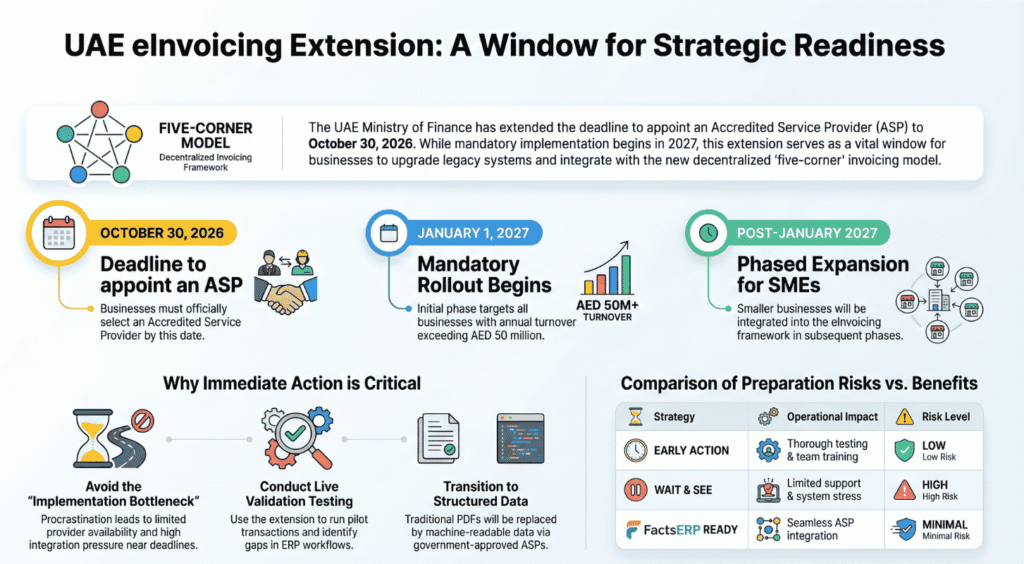
The Ministry of Finance has provided a clear trajectory for the transition. The mandate officially sets October 30, 2026, as the deadline for businesses to appoint an Accredited Service Provider (ASP). This is the final gate before the mandatory rollout begins on January 1, 2027.
This period is intentionally designed for rigorous testing and the complete redesign of internal workflows. The takeaway for the C-suite is clear: this is the time to move from conceptual awareness to technical execution.
“For businesses across the UAE, this extension is an opportunity to prepare properly, test systems thoroughly, and ensure a smooth transition before mandatory implementation begins in 2027… it is the ideal time for organizations to move from awareness to action.”
3. Beyond the PDF: The "Five-Corner Model" and the End of Post-Event Reporting
One of the most persistent misconceptions in the market is that eInvoicing is simply a transition from paper to PDF. In reality, the UAE is moving toward Machine-to-Machine (M2M) communication using Structured Data (XML/UBL). While a human can read a PDF, a government server cannot instantly verify its contents without complex OCR; structured data allows for the automated, real-time validation the Federal Tax Authority (FTA) requires.
The UAE will adopt a decentralized “Five-Corner Model” for secure invoice exchange. In this framework, the FTA is no longer a passive recipient of quarterly reports; they become a silent participant in the transaction, receiving data almost simultaneously with the recipient. This represents a seismic shift in digital transparency. It effectively ends the era of “post-event” reporting, making errors high-stakes and immediate. If your data isn’t structured correctly at the point of origin, the transaction—and your compliance—stalls instantly.
4. The AED 50M Filter: Why Enterprise Compliance Dictates SME Survival
The phased rollout begins on January 1, 2027, targeting businesses with an annual turnover exceeding AED 50 million. This threshold is the first domino in a universal market shift that includes both B2B and B2G (Business-to-Government) transactions.
For companies with government contracts, compliance is an immediate prerequisite for payment. However, there is a secondary “supply chain domino effect” that smaller vendors must realize: for a large enterprise (>AED 50M), an invoice from a non-compliant small vendor becomes a “data dead-end.” To maintain their own automated, structured M2M workflows, these giants will likely mandate eInvoicing for all their vendors, regardless of the vendor’s actual turnover. To remain a preferred supplier, SMEs must adapt now or face being cut out of the supply chain entirely.
5. Navigating the "ASP Bottleneck" through Provider Agility
As the October 2026 deadline for ASP appointment nears, a “sharp increase” in demand for Accredited Service Providers and compliance consulting is inevitable. Organizations that wait to secure these partnerships face several strategic risks:
- Vanishing Implementation Windows: As providers become overbooked, the time available for bespoke integration shrinks.
- Compromised Quality: Rushed deployments lead to higher integration pressure and potential operational disruptions.
- Locked-In Vulnerability: Many ERPs “lock” users into a single gatekeeper.
A key strategy for risk mitigation is adopting a solution like FactsERP, which emphasizes Provider Agility. By being integrated with multiple approved ASPs, FactsERP allows businesses to choose the provider that fits their specific operational needs. This multi-ASP approach serves as a critical hedge against potential ASP price hikes or technical downtime, ensuring the business is never tethered to a single point of failure.
6. An "All-Hands" Operational Shift
Digital transformation on this scale is never just an IT project. The eInvoicing mandate is a fundamental operational shift that requires coordination across Finance, Tax Compliance, Procurement, and IT.
Legacy systems and heavily customized workflows face the highest degree of risk. These systems often require significant lead time to ensure they can handle structured data without breaking existing approvals or reporting flows.
“Implementation is not just a technical upgrade. It impacts finance operations, tax compliance, approvals, reporting, procurement, and customer/vendor invoice flows.”
7. Real-World Readiness: The Advantage of Early Testing
The most forward-thinking businesses in the UAE are already moving beyond the planning phase. We are currently seeing “insider” organizations conducting live test entries and transaction validations to ensure their ERP systems can communicate seamlessly with ASPs and the FTA’s framework.
The advantage of pilot testing today is the ability to identify operational gaps—such as missing tax configurations or fragmented approval workflows—long before they become legal or financial liabilities in 2027. Early adopters aren’t just checking a compliance box; they are stress-testing their business for the digital age.
Conclusion: From Compliance to Digital Maturity
The extension to October 2026 should be viewed as a strategic gift—a window to ensure the market transitions without a loss of stability. The UAE’s move toward digital transparency is part of a broader vision to modernize the digital economy, streamlining transactions across the board.
Ultimately, this transition is about more than avoiding a fine; it is about Digital Maturity. Businesses that use this time to evaluate systems, train teams, and implement real-world testing will find the 2027 rollout to be a seamless evolution rather than a disruptive shock.
When the mandatory rollout begins in 2027, will your business be leading the digital curve, or struggling to catch up with a last-minute integration?